

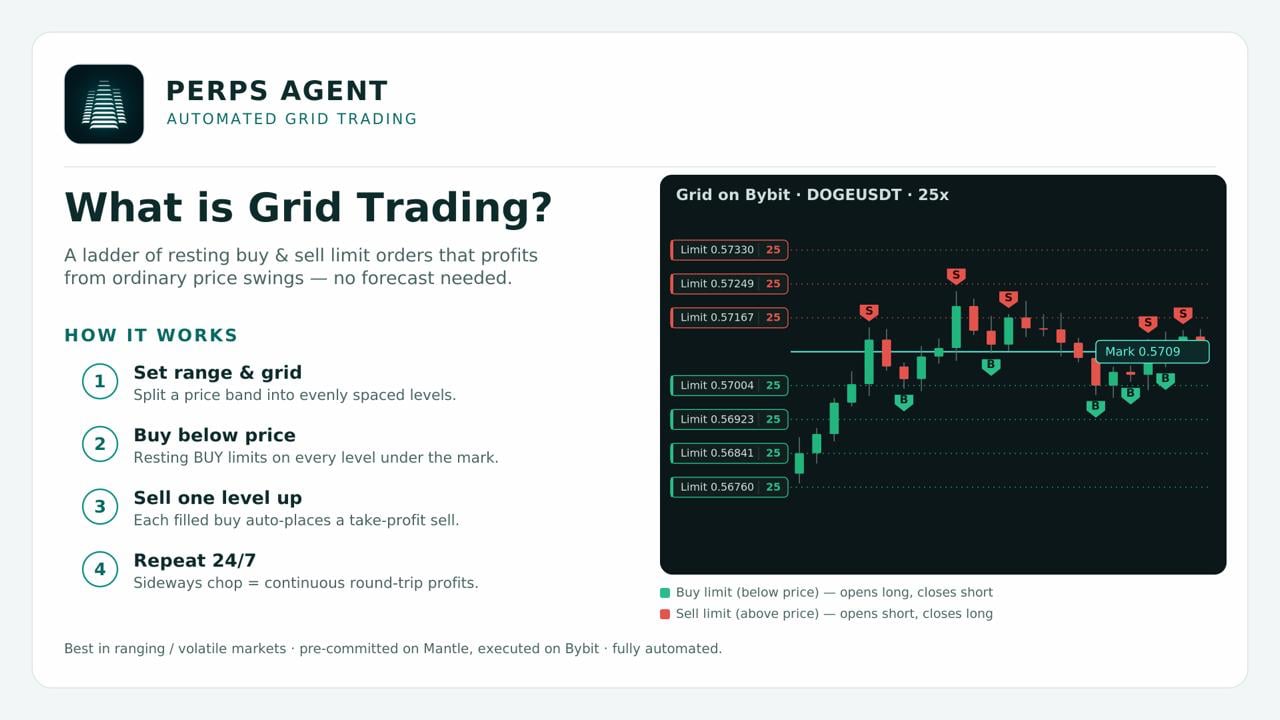
What a grid is
A grid strategy places laddered buy and sell orders at fixed intervals around a price range. When price oscillates inside the range, the engine harvests the spread between fills. The grid wins on volatility and pays for it during trends.How it works
A ladder of resting buy & sell limit orders that profits from ordinary price swings — no forecast needed.1
Set range & grid
Split a price band into evenly spaced levels.
2
Buy below price
Resting BUY limits sit on every level under the mark.
3
Sell one level up
Each filled buy auto-places a take-profit SELL one level higher.
4
Repeat 24/7
Sideways chop = continuous round-trip profits.
Buy limit (below price) — opens long, closes short. Sell limit (above price) — opens short, closes long. Best in ranging / volatile markets · pre-committed on Mantle, executed on Bybit · fully automated.
What the engine does
- Generates the ladder from the committed config: range, step size, order count, and notional per level.
- Places and refills orders through the exchange adapter as fills arrive.
- Tracks live state: inventory, realized PnL, unrealized PnL, drawdown, and risk metrics.
- Enforces caps: hard stops on max drawdown, max leverage, and max position size.
- Reports outcomes to the proof layer at the end of every run.
What it does not do
- It does not invent its own parameters — those come from the AI loop and are committed on-chain.
- It does not move funds — capital stays on the venue under user keys.
- It does not edit the track record — only the proof layer writes history.